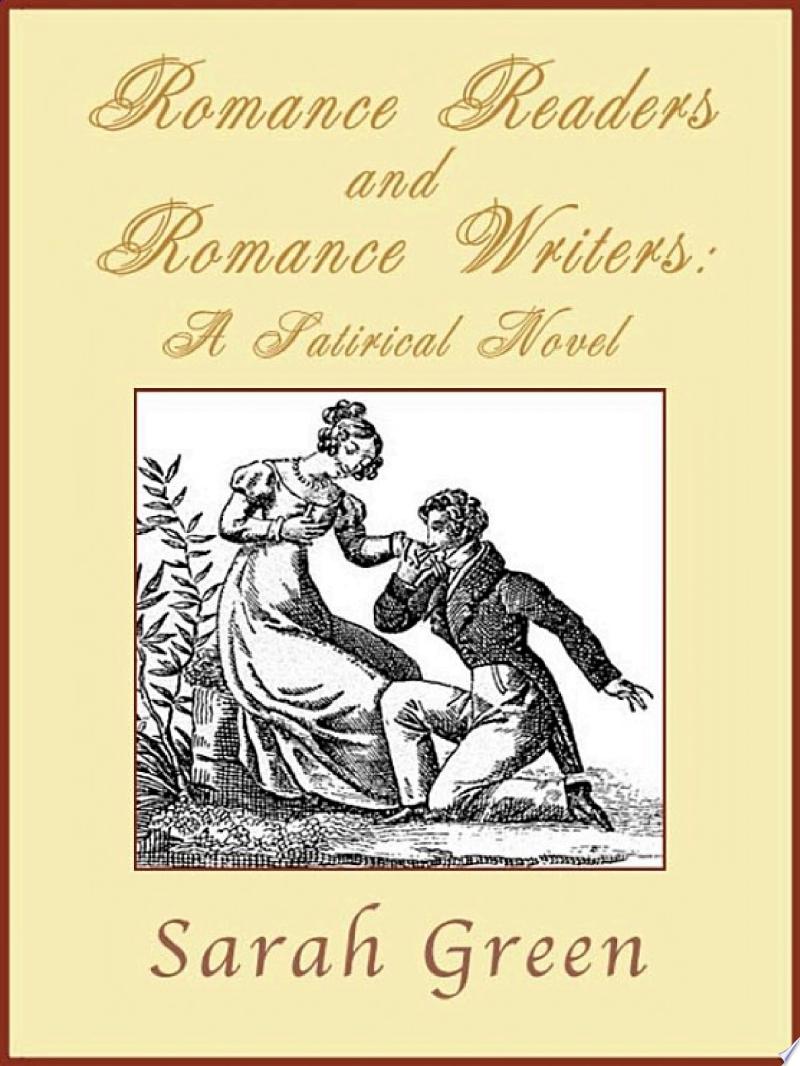
Romance Readers and Romance Writers: A Satirical Novel by Sarah Green
Published by Minerva Press on November 8, 2026
Genres: Fiction/Satirical Romance
Pages: 441
Format: eBook
Buy on Amazon


“Romance Readers and Romance Writers” (1810) is a satirical novel in which she sets out “to shew the effects of romance-reading on the weak and ductile mind of youth.” Green’s Quixotic young heroine, who avidly devours popular romances, especially those of the Gothic variety, begins by taking a more romantic name (“. . . Peggy? My name, sir, is Margaritta; and to no other name will I, hereafter, give an answer.”). Her life is imbued with the aura of her favorite genre. She convinces herself, for example, that her uncle's country house is haunted because at night she hears noises “which proceeded from no other cause than what is very common in such old houses, which was an army of rats.” In a witty and entertaining preface, Green critiques the work of a number of the popular romance writers of her day, beginning by pronouncing that “Romance proved favourable to the cause of gallantry and heroism during the dark ages, but we, thank heaven! live in more enlightened days.”
I am always looking for something that gets close to how much I love Northanger Abbey. So in my research when I ran across a synopsis of this book, you know I had to pick it up.
Jane Austen is a satirist, but she does also provide the HEA that makes her popularly considered a romance novelist. Sarah Green, on the other hand, wanted to burn romance to the ground. At least, that is my takeaway from Romance Readers and Romance Writers.
I read a lot of Regency contemporary stories, documents, books, and newspaper articles so I am fairly familiar with the cadence and style of writing. I want to be clear out of the gate that this book has its moments where its hard to read. In part, because as a serialised novel there are a lot of seeming unrelated scenes and a huge cast of characters to contend with. Green pulls it altogether in the end, but at times I was confused by the jumps from chapter to chapter, wondering what was going on. Skim reading, although you may be tempted, is not recommended. If you haven’t read a lot of late 18th, early 19th century literature beside Jane Austen, this is not a place to start.
But, if you are up for an adventure this book is bananas in the best way.
First, while there is no on page intimacy there is a whole lot more scandalous action happening in this book than is even ever implied in Jane Austen. The heroine (and I say that loosely, because we follow a lot of different characters throughout) had a transformation, in part because she is introduced to and influenced by some frankly garbage tonnish women. One of her idols is a straight up lothario. Which, good for her, but then she hurts a lot of people along the way so yikes. She has a foil in a beautiful, virtuous older sister who goes through her own ‘makeover’ and while her ending is probably one of the happier adjacent of the story, still suffers some surprising hardships in the third portion of the book.
Most of the people in this book are awful, and Green seems to underscore what a bad situation marriage is for most people, but particularly women. While on the one hand she is very anti-romantic (and gothic) novels, and seems to rage about thinkers like Wollstonecraft, on the other hand I got feminist vibes from this book. It’s like the modern debate where some people don’t understand what feminism, especially intersectional feminism, really is and assume it’s just misandry.
There are a lot of inside-ish jokes that you have to be fairly steeped in the Regency to get — the book just isn’t as tight or accessible as Jane Austen or other literary classics from the era, but its so interesting for its gratuitous exploitation of class, sex and gender, religion, and ethnicity. There is also a lot of free love happening, again not on page, but talked about and implied which gives this a higher flame rating for mature themes. Not a ton of violence, except for one duel, so most of what you grapple with is the scandalous behavior of, particularly the fashionable upper class, people and its impact on the middling and working class characters.
No one gets a happy ending, except for a very minor Irish working class character. I think most of the endings are just and mundane in their conclusion, meaning its a pretty pragmatic view of what was happening around Green.
At the end of the day, I liked this book. It was hard to get into, but the ending paid off in an interesting way, and I think it deserves more attention than it gets. Christopher Goulding in a new edition foreward talks about how the fact it was published by Minerva Press tainted it for a long time from discovery. Thankfully, there are a lot of scholars who have invested an incredible amount of time preserving gothic literature as well as satirical literature, because I think you cannot truly understand the Regency era without sampling some of these popular publications. In particular, a lot of these women authors were warning their primary audience, female readers, about the dangers of overromanticising life via the influence of romance novels.
This book also was a satirical follow up to the Don Quixote mania of the 18th century, following the tradition set by Charlotte Lennox with her 1752 The Female Quixote, that parodied Cervantes’ book and sends up the romantic novel. (Tartari, 2021) Lennox’s book was believed to be the model for Northanger Abbey, and is ranked high as an early modern novel. Green would have been aware of this tradition, and revisted it over half a century later with Romance Readers.
Tartari, A. (2021). Charlotte Lennox’s The Female Quixote and the dangers of romance-reading.
Discover more from Regency Reader
Subscribe to get the latest posts sent to your email.